Home›Resources›Carbon accounting in shipping
Carbon accounting in shipping: what the EU rules actually require
Carbon accounting and decarbonisation are expanding in shipping right now, and for good reason. The rules are moving fast, and the different methods used to measure emissions can make the whole thing feel confusing. This article brings some clarity, whether you supply, ship, or operate in this industry.
Article · For maritime SME suppliers
Why this matters
Two EU rules apply directly to shipping: the EU Emissions Trading System (EU ETS), extended to maritime transport from 2024 and reaching full coverage in 2026, and the FuelEU Maritime Regulation, in force since January 2025. Together they make in-scope ships monitor their emissions, pay for what they emit, and move to cleaner fuel over time.
Both apply to ships of 5,000 gross tonnage (GT) or more. Smaller vessels are not in scope for the carbon price itself, but general cargo and offshore ships between 400 and 5,000 GT must already monitor and report their emissions, and regulators are reviewing whether to widen that scope further.
There is a third layer. Companies that fall outside those two rules but must comply with the Corporate Sustainability Reporting Directive (CSRD) still have to disclose the emissions of transporting the products they buy and sell. For that, CSRD relies on the GHG Protocol, a widely adopted framework for measuring emissions at company, product, project and city level.
How are maritime emissions measured?
Two systems do the measuring, and they are not the same thing.
The EU's Monitoring, Reporting and Verification Regulation (MRV) is the legal backbone behind EU ETS and FuelEU. It sets out exactly how an in-scope ship must track and report its fuel use. It is mandatory, not optional, for any ship it covers.
The GHG Protocol is different. It is the globally recognised standard for measuring GHG emissions, used voluntarily worldwide. It matters here because it is also the accepted basis for reporting under CSRD, which gives it legal weight of its own.
| EU MRV | GHG Protocol | |
|---|---|---|
| What it is | Regulatory monitoring rule | Voluntary accounting standard (used by CSRD) |
| What it covers | One ship's fuel use, per voyage | A company's whole footprint, all year |
| Mandatory? | Yes, for in-scope ships | Via CSRD for in-scope companies |
| Boundary | Combustion (tank-to-wake); FuelEU adds well-to-wake | Scope 1, 2 and 3 (well-to-wake for value-chain fuels) |
| Who needs it | Ship operators in EU ETS / FuelEU | CSRD companies, and their suppliers |
Which rules apply to which companies?
Different requirements apply to different types of company.
| Type of company | What applies |
|---|---|
| Operates ships above 5,000 GT calling at EU/EEA ports | Full scope: EU ETS and FuelEU Maritime |
| Operates general cargo or offshore ships 400 to 5,000 GT | MRV monitoring obligations only, for now |
| In CSRD scope, regardless of the above | Full Scope 1, 2 and 3 footprint under the GHG Protocol. For logistics, the emissions of transporting the goods it buys and sells (Scope 3 Categories 4 and 9) |
| Fuel supplier to an in-scope (FuelEU Maritime) company | Expect requests for fuel intensity data, including upstream emissions |
| Shipping service provider to a CSRD company | Expect requests for shipping emissions figures, well-to-wake, per the GHG Protocol / GLEC / ISO 14083 |
| Any other supplier to a maritime company in CSRD scope | Expect requests for a product or service emissions figure |
How do EU MRV and the GHG Protocol relate?
They measure the same fuel, but they draw the line in different places. The easiest way to see the difference is to ask how much of the fuel's life each one counts.
- Tank-to-wake means the emissions from burning the fuel on board, what actually comes out of the funnel.
- Well-to-wake adds the emissions created before the fuel ever reached the ship: extracting the oil or feedstock, refining it into fuel, and moving it to the tank. Well-to-wake is simply tank-to-wake plus that upstream production.
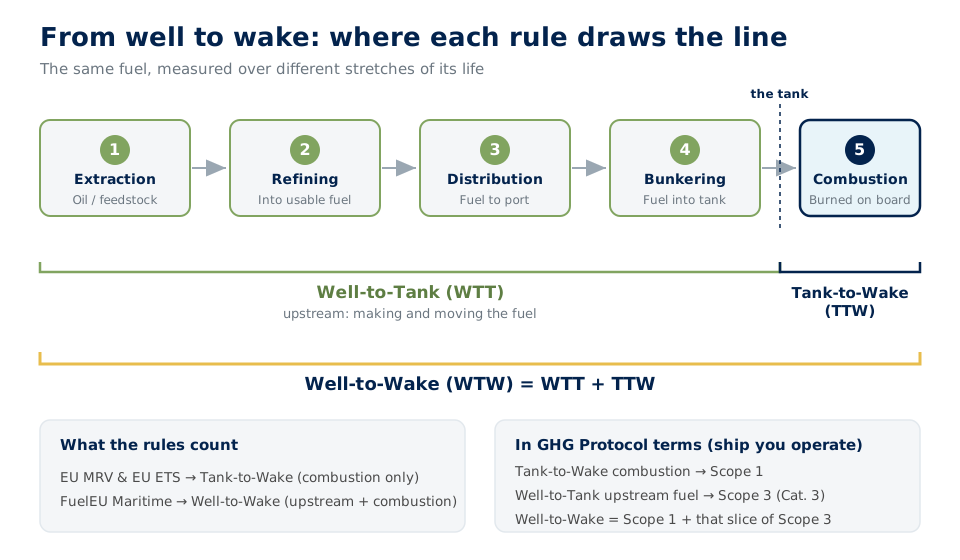
The EU rules split along exactly this line. EU MRV and the EU ETS count the tank-to-wake emissions of an in-scope voyage: the CO2 (and, from 2026, methane and nitrous oxide as well) released as the ship burns fuel. MRV is the measuring and reporting backbone; the ETS puts a price on that number. FuelEU Maritime goes wider: it caps the well-to-wake greenhouse-gas intensity of the energy a ship uses, so it also counts the upstream production of the fuel. Same fuel, longer stretch of its life.
The GHG Protocol counts a company's whole footprint, everywhere, all year, split into Scope 1 (fuel the company burns directly), Scope 2 (energy it buys) and Scope 3 (everything else in its value chain). The two EU terms map onto it neatly.
| The fuel stage | Scope | GHG Protocol |
|---|---|---|
| Burning fuel on a ship you operate | Tank-to-wake | Scope 1 |
| Making and moving the fuel | Well-to-tank | Scope 3 (Category 3) |
| Both together | Well-to-wake | Scope 1 + a slice of Scope 3 |
So the well-to-wake figure FuelEU asks for is, in Protocol language, Scope 1 plus one slice of Scope 3. The GLEC Framework and ISO 14083 in turn provide transport-specific rules aligned with the GHG Protocol, also on a well-to-wake basis, for shipping and every other mode.
The two are not interchangeable. A regulation prices or caps one number on the voyages it covers; the Protocol builds the company's full annual picture. A company can be fully compliant on MRV and still have a Scope 3 gap its customers care about, or the reverse. Getting both right is what separates a report that satisfies a regulator from one that satisfies a customer.
From measuring to acting
Getting the number right is step one. What you do with it, and how you turn it into an advantage with your customers, is where the value is.
Decarbonisation: what happens after the numbers are run?
Measuring emissions is only the start. The real value is in finding where the emission hotspots sit, and where decarbonisation can actually reduce them in the most cost-efficient way.
There are different reasons why a company can have a decarbonisation plan that includes its supply chain emissions. As mentioned before, a company under CSRD scope requires one for compliance purposes. Additionally, companies that follow voluntary certifications like Ecovadis, Carbon Disclosure Project (CDP) or the Science Based Targets initiative (SBTi) are also required to engage their suppliers to report and reduce their emissions. That puts suppliers offering low-carbon products or services in a strong spot: they help their customers meet that obligation, which becomes a commercial advantage in its own right.
| Measure | What it does | Named in FuelEU? |
|---|---|---|
| Lower-carbon fuels (biofuels, methanol, renewable e-fuels such as green ammonia) | Cuts the well-to-wake intensity of the energy used | Yes; RFNBO e-fuels get a reward multiplier |
| Wind-assisted propulsion | Reduces the fuel needed for a voyage | Yes, via a reward factor |
| Shore power at berth | Replaces auxiliary-engine burning with grid electricity in port | Yes, from 2030 for larger ships |
| Operational efficiency (speed, routing, maintenance) | Lowers the absolute fuel burned, reducing voyage emissions | Not directly; helps absolute emissions |
Because FuelEU rewards fuels on a well-to-wake basis, a fuel only helps if its production emissions are low too, not just what comes out of the funnel.
Each of these only works as a strategy once a company has a reliable number to measure it against, which is why getting the accounting right comes first. Each measure can be expressed in euros per tonne of CO2 equivalent reduced, a simple indicator of what it costs to cut one tonne through each alternative. Ideally a business starts with the low-hanging fruit, the measures that remove the most emissions for the least cost, and works up from there.
This article reflects The Circular Bulb's interpretation of the current regulatory landscape and is provided for general information. TCB is not a law firm and does not provide legal advice. Verify the obligations that apply to your specific business before acting.
Back to resourcesWorking out where your emissions sit?
Or what a customer is about to ask you for? Book a free 15-minute call to talk through your situation. No agenda required.
Book a 15-minute call